
Unveiling the Moon’s Secret: The Moon has fascinated humans for millennia, guiding our calendars, influencing ancient myths, and even affecting scientific understanding of Earth’s natural rhythms. Yet, many people are unaware that our lunar companion is slowly drifting away from Earth, a subtle movement that impacts our days and tides over time. Understanding this phenomenon offers not only astronomical insight but also a glimpse into how interconnected our planet is with its nearest celestial neighbor.
The Moon: Earth’s Celestial Companion
The Moon is Earth’s only natural satellite, orbiting at an average distance of about 384,400 kilometers. Unlike planets, which orbit stars, moons orbit planets, and Earth’s Moon is especially influential due to its size relative to our planet. Its gravitational pull is the primary reason for tides and has played a crucial role in stabilizing Earth’s axial tilt, which affects our climate over millennia.
Formation of the Moon
Scientists widely agree that the Moon formed roughly 4.5 billion years ago, shortly after the Earth itself formed. The prevailing theory, known as the giant impact hypothesis, suggests that a Mars-sized body collided with Earth, ejecting debris into orbit that eventually coalesced to form the Moon. This early collision set the stage for the Moon’s ongoing dance with Earth, a relationship that continues to subtly shape life on our planet.
The Moon’s Gradual Drift from Earth
Contrary to the static image often portrayed in popular culture, the Moon is not fixed in its orbit. Measurements using lunar laser ranging—where scientists bounce lasers off mirrors left on the Moon by Apollo astronauts—have shown that the Moon drifts away from Earth at a rate of approximately 3.8 centimeters per year.
Why the Moon Drifts Away
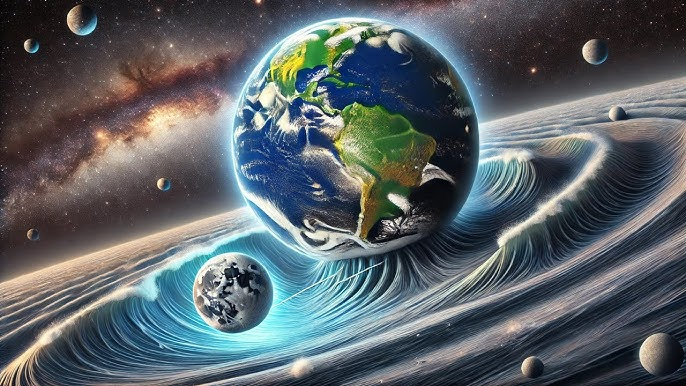
This drift is primarily caused by tidal interactions between Earth and the Moon. As the Moon’s gravity pulls on Earth, it creates ocean tides. The friction between moving tides and Earth’s rotation transfers rotational energy from Earth to the Moon. This energy exchange slightly slows Earth’s rotation while pushing the Moon into a slightly higher orbit.
Implications for Earth’s Rotation
As the Moon moves away, Earth’s rotation gradually slows. Hundreds of millions of years ago, a day on Earth lasted only about 18 hours. Today, we enjoy 24-hour days, and in the far future, our days could extend even longer. This subtle shift demonstrates how deeply interconnected Earth’s rotation is with lunar movement.
Deep Sea Shock: Giant Worms Discovered Beneath the Ocean Floor
How the Moon Influences Tides
Tides are one of the most visible effects of the Moon’s presence. They result from the gravitational pull of the Moon (and to a lesser extent, the Sun) on Earth’s oceans.
High Tide and Low Tide Mechanics
The side of Earth facing the Moon experiences a bulge of water due to gravitational pull, creating high tide, while the opposite side experiences another high tide due to centrifugal forces. Between these bulges, water levels drop, forming low tides. This cycle repeats approximately every 12 hours and 25 minutes, governed by the Moon’s orbit.
Changing Tidal Patterns Due to Lunar Drift
As the Moon drifts away, the tidal forces it exerts weaken slightly. While this change is minimal in human lifespans, over millions of years it can alter tidal ranges and influence marine ecosystems. Coastal regions, which rely on tides for sediment transport and nutrient cycling, may see gradual changes in their environmental dynamics.
Historical Evidence of Changing Days and Tides
Evidence of the Moon’s influence is not only theoretical. Geological and fossil records provide a window into how Earth’s rotation and tides have evolved.
The Dangerous Garden Plant That Attracts Snakes and Why Experts Say You Should Avoid It
Fossil Corals and Daily Cycles
Certain fossil corals grow in daily layers, much like tree rings. Scientists studying ancient corals have counted growth layers, revealing that hundreds of millions of years ago, there were approximately 400 days in a year, compared to our current 365. This demonstrates that Earth’s rotation has indeed slowed over time, consistent with the Moon’s gradual outward drift.
Sedimentary Tide Patterns
Sedimentary rocks also preserve ancient tidal patterns. By analyzing these deposits, geologists can estimate tidal ranges from hundreds of millions of years ago. The evidence consistently points to stronger tides in the distant past, reinforcing the connection between Moon-Earth interactions and Earth’s environmental history.
Telstra Price Hike Shock: Mobile Customers Hit Again as Cheapest Plan Disappears
The Moon’s Role in Stabilizing Earth’s Climate
Beyond tides and days, the Moon contributes to the stability of Earth’s axial tilt. The axial tilt affects seasonal variations and long-term climate patterns. Without the Moon’s stabilizing influence, Earth’s tilt could vary dramatically, leading to extreme climate fluctuations that could challenge life as we know it.
Axial Tilt and Climate Variability
Currently, Earth’s axial tilt is about 23.5 degrees, providing a balanced range of seasonal changes. The Moon’s gravitational pull keeps this tilt relatively stable. As the Moon drifts away, the stabilizing effect diminishes very slowly, potentially increasing axial tilt variability over billions of years.
The Future: Longer Days and Weaker Tides
What does the Moon’s slow drift mean for the distant future of our planet? While humans will not directly notice major changes in our lifetime, astronomical projections give fascinating insights.
Longer Days
As Earth’s rotation continues to slow, days will gradually lengthen. In a few hundred million years, days could be several minutes longer than today. While this may seem negligible, over geological time, it significantly impacts the biological rhythms of organisms, from plankton to mammals.
Experts Warn: Ocean Iron Shortage Is Slowing Phytoplankton Photosynthesis and Urgent Action Is Needed
Weaker Tides and Ocean Currents
With the Moon moving farther away, tidal forces will weaken slightly. This could reduce tidal ranges, affecting coastal erosion, sediment transport, and even the migration patterns of marine species that rely on tidal cues.
Human Perception and Cultural Significance of the Moon
Humans have always been keenly aware of the Moon’s cycles. Its phases influenced calendars, agricultural practices, and religious rituals.
The Hidden Progress Trap: How Your Brain Secretly Tricks You Into Thinking You’re Not Growing
Calendars and Lunar Phases
Ancient civilizations like the Babylonians, Egyptians, and Mayans developed lunar-based calendars to track months and seasons. Even today, cultural festivals in many parts of the world align with full or new moons.
Myths and Folklore
The Moon’s steady presence has inspired countless myths, legends, and artistic expressions. From werewolves to love poems, the Moon symbolizes change, mystery, and continuity, reflecting the slow but impactful changes it imposes on our planet.
Shocking €7 Billion Military Scandal: The British Army Project That Spiraled Into a Costly Crisis
Scientific Observation of the Moon’s Drift
Modern science has allowed us to quantify and predict the Moon’s drift with remarkable precision.
Lunar Laser Ranging
The Apollo missions placed retroreflectors on the Moon’s surface, enabling scientists to measure the distance between Earth and the Moon to millimeter precision using lasers. This data confirms the Moon’s gradual outward motion and provides a tool for studying Earth-Moon dynamics over time.
Satellite Observations
In addition to laser ranging, satellites equipped with radar and gravitational sensors monitor the Moon’s orbit, tides, and Earth’s rotation. These observations improve our understanding of how small gravitational shifts can accumulate over millions of years.
The Interconnectedness of Earth and Moon
The Moon’s slow drift reminds us that Earth does not exist in isolation. Its rotation, tides, and even climate are influenced by celestial forces. Understanding these interactions highlights the delicate balance that sustains life and the precision required in celestial mechanics.
Joint Pain Breakthrough: The Surprising Exercise Doctors Say Works Better Than Swimming or Pilates
Lessons for Earth’s Future
By studying the Moon-Earth relationship, scientists can better predict long-term changes in Earth’s environment, ocean currents, and climate stability. These insights are critical not only for understanding the past but also for preparing for potential future shifts in Earth’s natural systems.
Conclusion
The Moon is more than a distant rock orbiting our planet—it is a silent architect of Earth’s natural rhythms. Its slow drift away from Earth subtly alters the length of our days, the strength of our tides, and the stability of our climate over geological timescales. By observing and studying this celestial dance, we gain not only knowledge of astronomy and geology but also a deeper appreciation for the intricate connections between our planet and its companion in space.
The Career Boosting Secret: Why a Simple Lunchtime Walk Can Transform Your Success
Understanding the Moon’s influence reinforces a profound truth: even small, gradual changes in the cosmos can shape life on Earth in ways both visible and hidden. As it drifts away, the Moon continues to remind us of the enduring interplay between celestial forces and the rhythms of life on our planet.
FAQs
1. Why is the Moon drifting away from Earth?
The Moon drifts away due to tidal interactions between Earth and the Moon. As the Moon’s gravity pulls on Earth’s oceans, friction slows Earth’s rotation and transfers energy to the Moon, causing it to move into a slightly higher orbit at a rate of about 3.8 centimeters per year.
2. How does the Moon affect tides?
The Moon’s gravity pulls on Earth’s oceans, creating high and low tides. The side of Earth facing the Moon experiences a bulge of water (high tide), while the opposite side also has a bulge due to centrifugal forces. This cycle repeats roughly every 12 hours and 25 minutes, forming the tidal rhythm we observe.
3. Does the Moon drifting away change the length of our days?
Yes. As the Moon moves farther, Earth’s rotation gradually slows, making days slightly longer over millions of years. Hundreds of millions of years ago, days were only about 18 hours long. Today, we have 24-hour days, and they will slowly continue to lengthen in the distant future.